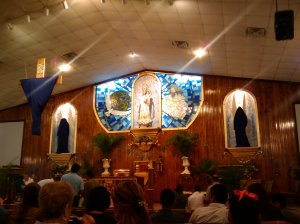
One of the biggest criticisms of the Catholic Church is that it is so bound by tradition and ritual that there is no true worship behind it. Protestant churches also have some traditions and rituals. Many people attend church and go through the motions with little faith in their hearts. They attend church but act contrary to its teachings. This is the opposite of the Good Samaritan types.
The point of these two opposite kinds of people is that being a part of organized religion does not guarantee salvation any more than being outside organized religion guarantees damnation. There are, however, advantages that come with organized religion versus being a closet practitioner.
There are many things that organized religion of any denomination can provide that the lone practitioner is missing. The greatest amongst these is community. You can think of being part of a community like you would think of being part of a company. It gives you a set of responsibilities. Organized religion teaches discipline through requiring attendance. It gives you accountability. It gives you resources to carry out good deeds. It gives you a set of guidelines to follow. It provides you a network of people with similar beliefs on which you can call. Organized religion also gives people who are interested, a mission to carry out. There are a lot of practical lessons outside of faith that being a part of a church community provides. Faith is just the icing on the cake.
There are also life lessons that organized religion provides. You learn financial discipline knowing that you should give a portion of your income. Organized religion gives you a family. Just like our own families, if we are a constant part of their lives, they will care for us and our welfare. If we are estranged, then they will act as estranged families do. Religion gives us ways to honor those people we love in life, and even in death. The single biggest lesson, if we are looking for it, is that you only get out of it what you put in. This is true in life, business, or any other endeavor that is worthwhile.
It is easy for the more intelligent amongst us to think that we can do it better and on our own. Organized religion easily seems like mind control for the masses. But, what if you submit willingly to the mechanisms? What if you are totally aware of what you are doing and why you are doing it. Is it really mind control? Don’t we practice rituals every day in other avenues of life?
The military, for example, is very steeped in discipline, tradition, compulsory actions, and sacrifice for others. Business is rife with protocols and processes. Government conducts most of its business through bureaucracy, mindless rituals on paper. Yet, we don’t pretend to be a military force of one, it is silly to conduct business with ourselves, and nobody would recognize a government of one person. We cannot practice a faith by ourselves either. We can fulfill the first half of the commandments at home. Despite our own egos, we never accomplish anything great on our own. There are always others who help us along.
If you look at just the Ten Commandments, half deal with your relationship with God, and half deal with your relationship with people. You can infer that he expects you to have a relationship with him AND with people. You cannot carry out the remainder of his commandments without dealing with people. You fulfill only part of his commandments when you pray in your closet. Without people, you don’t need religion. If you were the only person on Earth, you couldn’t honor your parents, commit murder, commit adultery, steal, bear false witness, or covet anything. Without people, it is very difficult to sin. If these opportunities to sin are gone, then why do you need God? You would not need his guidance or comfort. You would have no need to talk to him. Therefore, to believe that one can be faithful in private leaves out that we must do right by others so that we are right with God.
You cannot steal from somebody and then ask forgiveness from God while keeping the item. You should first make right your wrong and then ask forgiveness; that is repentance. It is through our relationships with people that we demonstrate the wisdom that God gives us. We show His wisdom by not sinning against people; and if we fail, by making right our wrongs.
We can sin by what we do; but, we can also sin in what we fail to do, like honoring Him in His house. I’ve looked at alternatives to being Catholic; but, everything requires some investment of time and discipline. If I was a bad Catholic, there was no way I’d be a better something else. If I could do better on my own, then why didn’t I already? If I can’t do right by fallible beings, what chance do I have in doing right by a perfect being? Lawrence Bell said, “show me a man who cannot bother to do little things and I’ll show you a man who cannot be trusted to do big things.” Similarly, Albert Einstein said, “whoever is careless with the truth in small matters cannot be trusted with the important matters.” By extension, if we cannot be bothered to do the small things required by our churches, how can we be bothered to do what it takes ask for our own salvation? When we belittle the practice of organized religion, we expose our own unwillingness to be humble, as if we have all the answers.
Ultimately, I decided to take the faith that I was given to me by my parents and run with it. It has a bureaucracy, an appeals system, community, several missions to carry out, a network around the world. Yes, I could pray on my own and worship God without going to church. I don’t go to church for salvation. I go to church for the intangibles that come with being a part of that community.
Do you belong to any clubs, organizations, associations, political parties, business entities, or other coalition of people? Don’t those offer other unintended benefits? Church is no different except that its main focus is around faith. You do not attend church and go through the rituals for salvation. That assumes you have control over God. Whether you practice in private or in church, that decision is beyond your control. You attend church to show humility and to join your family of fellow believers. Like soylent green, Church is people.
 Shaine